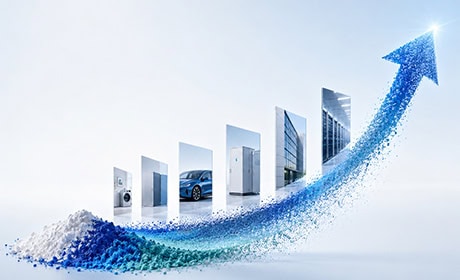
The global powder coating additives market is entering a steady growth trajectory. According to market data, the global powder coating additives market was valued at approximately USD 1.67 billion in 2024 and is projected to reach USD 2.52 billion by 2032, representing a compound annual growth rate (CAGR) of around 5.8%. Driven by increasingly stringent environmental regulations and the continuous expansion of downstream applications, the powder coating additives industry is accelerating its evolution toward low-temperature curing, green sustainability, functionalization, and intelligentization.
Lowering the curing temperature is one of the most active areas of additive R&D today. Traditional powder coatings require curing at high temperatures of 180–200°C, which consumes substantial energy and cannot be applied to heat-sensitive substrates such as wood and plastics. New additive formulations are now making it possible to cure at temperatures as low as 120–140°C. This not only significantly reduces energy consumption—with reported cases showing energy savings of up to 40% and efficiency improvements of 30%—but also extends the application boundaries of powder coatings to emerging fields such as electronic components and automotive parts. At present, some low-temperature curing additive products are already capable of achieving full curing within 25–30 minutes at 140°C.
The tightening of environmental regulations is a key driver behind additive innovation. In June 2026, China’s new national standard on Limits of Hazardous Substances in Coatings officially came into effect, imposing stricter requirements on VOC, SVOC, and other indicators. Against this backdrop, non-toxic, low-volatility, and biodegradable green additives are gradually replacing traditional highly toxic products. Meanwhile, bio-based additives have become a hot topic in R&D, with promising progress being made in the preparation of resins and curing agents from renewable materials such as furan dicarboxylic acid, lignin, and chitosan. In 2024, the adoption of bio-based additives grew by 22% year-on-year, indicating that market demand for sustainable solutions is accelerating.
Powder coating additives are evolving from single-function to multi-functional and intelligent solutions. Leveling and appearance additives continue to improve surface quality; film-performance-enhancing additives increase hardness, adhesion, and weatherability; and special-function additives cover personalized requirements such as high-temperature flame retardancy, antibacterial properties, anti-graffiti, and soft-touch effects. More forward-looking, “smart” additives with temperature-responsive or delayed-release functionalities are being developed, and properties such as self-healing and photocatalysis are also beginning to enter the R&D pipeline. In addition, artificial intelligence technologies are accelerating the screening of additive formulations, defect prediction, and process optimization, which are expected to significantly shorten R&D cycles.
Overall, the powder coating additives industry stands at a critical juncture of technological transformation. The convergence of low-temperature curing, green sustainability, and functionalization/intelligentization not only charts a clear course for industry development but also offers vast innovation opportunities for additive manufacturers.